

Seeing the River

I've been receiving a lot of posts for submission for approval for the group but have had to decline them (sadly!) as they are too far removed from the topic of identity disruption, although worthy in their own right and context.
We're all in a slow-moving tsunami of extremely pressing topics all around us, and I'd like to address that tsunami in itself, rather than the individual topics, and to do so in the context of identity disruption.
We must keep in mind the questions of "who is wanting to disrupt us all so much, and why???" We can point fingers at individual people or groups of people, or, we can fly high and metaphorically look down upon ourselves, gain perspective, start seeing the patterns on a large scale and over time- not just 20 years but over many decades and centuries- and then- the ah-hah moments will come- which is SUCH a great relief.
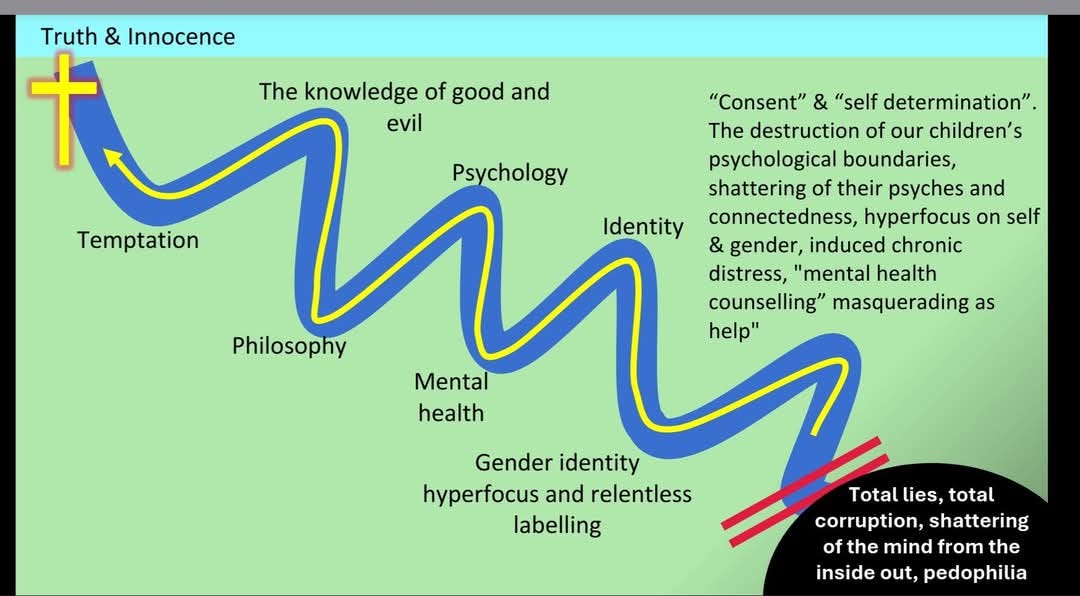
Please bear with me as I attempt to explain this diagram..
Humanity is in a constant struggle between choosing goodness or choosing evil, represented by this river. The choosing of goodness leads to a narrower and narrower path. The choosing of evil (which includes the failure to choose goodness) leads to more and more options of splintered paths. This particular diagram focuses on the aspect of identity disruption delivered through schools, but there are parallel diagrams (which I have to make) for other politicised aspects of our lives, like health, food supply, technology, land management, the media, language, etc.
In each case, those aspects of our lives have been ushered 'down the river' into increasing fragmentation and further away from the Truth.
So, depending upon your faith, or secularism, there will be a different top part of the river. For secular people, the top part of the river is most likely "common sense" which is a form of philosophy (see the position of 'philosophy' near the top of the river). For people who believe in God and Jesus Christ, He is the very top part of the river. But we now live in an age in which splintered fractured ideas are being blown in a whirlwind around us, through the media and other 'ideological state apparatus'. We could choose to switch off from it all and not engage, but what about the consequences of that? The failure to engage is like turning away from people who are drowning in an ocean of competing ideas, while we stand on the rock of Truth. That seems evil to me. So, we MUST engage and reach out to those who are struggling in this violent ocean of ideology. How? Its a massive task but I wonder if this simple diagram could be a tool to help others see the big picture, and to see where they are currently positioned, and then willingly move 'up the river'. So for example, secular psychologists of education may be earnestly wanting to help young people..but feeling very lost as they watch distress and despair around them. But if they could come to see that psychology of born of philosophy - which it is - then they could make the conscious decision to investigate the true Philosophy of Education, which is just one bend up the river. A philosophical approach to education is a 'seismic shift' (to use Rodney Hide's words) from a psychological approach to education. I'm so disturbed to see so many teacher resources which have a psychological agenda, such as 'mental health education' and 'social & emotional learning'. All of this is promoted as for the good of the child, but from the philosophical point of view, none of it is for the good of the child... and of course, that explains the distress that we see in not only our young people but also in the teachers. Teachers these days dont even have a memory or intuitive understanding of what True Education looks or feels like. I think we need to set up a buddy system of old teachers and young teachers, and old-school philosophers of Education need to be reinstituted to the helm of the Ship of Education, instead of the current psychologists of education.
Would love your comments.
Thanks
Hi Elisabeth, that was a good read. I agree with you. Secular common sense still kind of implies a direct relationship with common good. Without common good, how is common sense defined?
I think you're right about the state of education policy, the effect on students and teachers. It is symptomatic of cutting the anchor of christian morals and replacing them with secular(woke morals) With the traditional moral anchor cast aside, how is common sense defined by those in power now. It is no wonder we are where we are, but how do we get back on to the right path. I feel that is a collective moral solution imho. How do we effect such a change?
I agree with you, and I think your idea is sound and quite a unique perspective. Christ at the end of the river means something quite different for me. The hermit prophets, the old monasteries, and the monastic element is something that appeals to me. I feel one can choose to live such a life of devotion, even in this age. Devoting every moment to Him, much easier as a hermit or following that simple monastic life. I think 'true education' is in the eye of the beholder and as such pretty subjective. Success in the world does not always lead to success in the eternal, and vice versa. Just my two cents.
I understand what you mean by fracturing the mind at a young age, MK ultra used similar methods and Tavistock uses mass trauma for mass programming the same way. Covid is a great example but there are many. Difficult to see any other solution to that other than an awakening and a collective moral solution imho. Collective macro moral change only occurs through a large enough 'critical mass 'of individual micro moral change, large enough to change the social moral climate of the day. It seems to have happened now for covid. Most know there were many things that were wrong about it. However, the moral change and realisation of what was wrong hasnt occurred to the extent that the majority are willing to protest loudly enough to hold those responsible accountable.
Im sorry if I sound pessimistic, I dont mean to. I think its an enormous task, but no tasks get done by doing nothing. I think its peoples minds and moral fibre that really needs to change, and the willingness to fight for what is right. Am I even correct in assuming most know better now, maybe not, apparently.
Good work Elisabeth I think its good work, all the best.
Have you ever thought of writing a book? You write well.